Anthropic's Official 'Introduction to Agent Skills' Course, Now a Korean Tutorial
All six chapters of Anthropic's official course 'Introduction to agent skills' are now available as a Korean tutorial. General skills courses stop at personal productivity tips; the official curriculum goes on to priority hierarchies, organization-wide deployment, and tool restrictions. This post also covers what Modern Web Labs added, including a comparison of rules files and skills that the original course never had.
A familiar scene in organizations that have adopted Claude Code: one engineer asks for a PR (pull request) review and gets back something that already matches the team's conventions. The engineer at the next desk uses the same tool and has to spell out the format from scratch every time. The difference between them is not ability. It is the difference between teaching the tool once and explaining yourself again every time.
Skills are the Claude Code feature that removes this repetition.1 Put a repeated instruction in a SKILL.md file once, and Claude applies it automatically whenever it recognizes a related request. The problem is what to learn from. Most of the skills tutorials that turn up in search are blog summaries or video recaps. They leave you with fragments of knowledge rather than a framework you can apply across a team.
Modern Web Labs has published a Korean tutorial based on Anthropic's official course 'Introduction to agent skills'2. The tutorial goes beyond translation. It covers ground the original could not, such as rules files, which Claude Code added after the course was released. This post walks through how the tutorial is put together and what an organization gains by learning from an official curriculum instead of a generic skills tutorial.
Six chapters, an official curriculum in under two hours
The Korean tutorial has six chapters. Each takes about 15 to 20 minutes, and the whole series runs under two hours. Chapters 1 and 2 are open to everyone; chapters 3 through 6 are reserved for Modern Web Labs clients.
Chapter | What it covers | Access |
|---|---|---|
How they work, where they live, how they differ from CLAUDE.md and slash commands | Free | |
Writing and validating | Free | |
| Clients only | |
4. Skills vs. CLAUDE.md, rules files, subagents, hooks, and MCP | Feature-by-feature comparison and how to combine them, plus an added rules file comparison | Clients only |
Sharing via repositories, plugin distribution, enterprise managed settings | Clients only | |
Diagnosing trigger, load, priority, and runtime errors | Clients only |
Each chapter embeds the original lesson video unchanged, with a Korean summary alongside it so you can follow along without watching. We added everyday examples, such as ordering your usual at a cafe or filling in a meeting-notes template, so non-developers can grasp what a skill is. The series page also collects eight FAQ entries, among them "How is a skill different from CLAUDE.md?" and "What do I do when a skill doesn't trigger?"
What sets the official curriculum apart for an enterprise
There is no shortage of content on skills. Most of it stops at individual productivity: create a SKILL.md, verify the trigger, speed up your own work. It leaves out what an organization weighing team-wide adoption actually needs to know. Who should own which skills, which one wins when names collide, and how do you deploy and govern them across the whole organization?
One employee who is good at Excel does not standardize the company's report templates. One person using a tool well and an organization adopting that tool as a standard are different problems. The value of Anthropic's official curriculum is that it builds that organizational axis into its design from the start. Five points stand out.
Priority hierarchy (Chapter 2): When the same skill name exists in several locations, priority runs Enterprise → Personal → Project → Plugins. The hierarchy puts organizational standards ahead of individual settings by design.
Three deployment paths (Chapter 5): The curriculum spans every scale: committing to a repository to share with the team, distributing through plugins and marketplaces, and rolling out organization-wide through enterprise managed settings.
Tool access restrictions (Chapter 3):
allowed-toolslimits which tools Claude can use while a skill is active. It is the control you need for read-only tasks and security-sensitive workflows.Managing context cost (Chapter 3): Progressive disclosure keeps
SKILL.mdlight and has Claude read the detailed material only when it is needed. Operational knowledge of this kind shows up directly in token cost and response quality.Troubleshooting framework (Chapter 6): The curriculum walks through a diagnostic sequence for triggers that never fire, load failures, priority conflicts, and runtime errors. It also covers the skills validator and
claude --debug.
If you are evaluating Claude Code adoption and building official skills for a team, these five points are your checklist. Take the material you are working from today and see whether it covers priority, deployment, and governance. If it does not, you are reading a personal productivity guide, not a team adoption guide.
Newsletter
Notes vetted by enterprise practitioners, every two weeks.
Notes on Claude Code, GitHub Copilot, AI-native engineering strategy, and adoption case studies, curated every two weeks.
What Modern Web Labs added
The official course has its gaps too. It cannot cover what Claude Code shipped after the recording. Rules files are the clearest example (official docs). They let you split CLAUDE.md across several files, and once you set the paths frontmatter, the instructions in a rules file load only when Claude works with files under those paths. That "load only when needed" behavior is what makes them easy to confuse with skills.
So we added a comparison of the two to Chapter 4. The deciding factor is the trigger. A skill matches on the user's request; a path-scoped rules file matches on the files Claude is working with. To answer "write a PR description," reach for a skill. To attach validation rules every time someone edits a file under src/api/, reach for a rules file.
We also documented when subdirectory CLAUDE.md files load. Claude loads the CLAUDE.md in the working directory and in every directory above it at session start, but a subdirectory CLAUDE.md loads only when Claude reads a file in that subdirectory. So pulling out the instructions that apply to a single module saves context much the way a path-scoped rules file does. A single diagram lays out when the root CLAUDE.md, a rules file, and a subdirectory CLAUDE.md each load in a monorepo. Chapter 5 adds a directory-structure diagram for distributing skills as plugins.
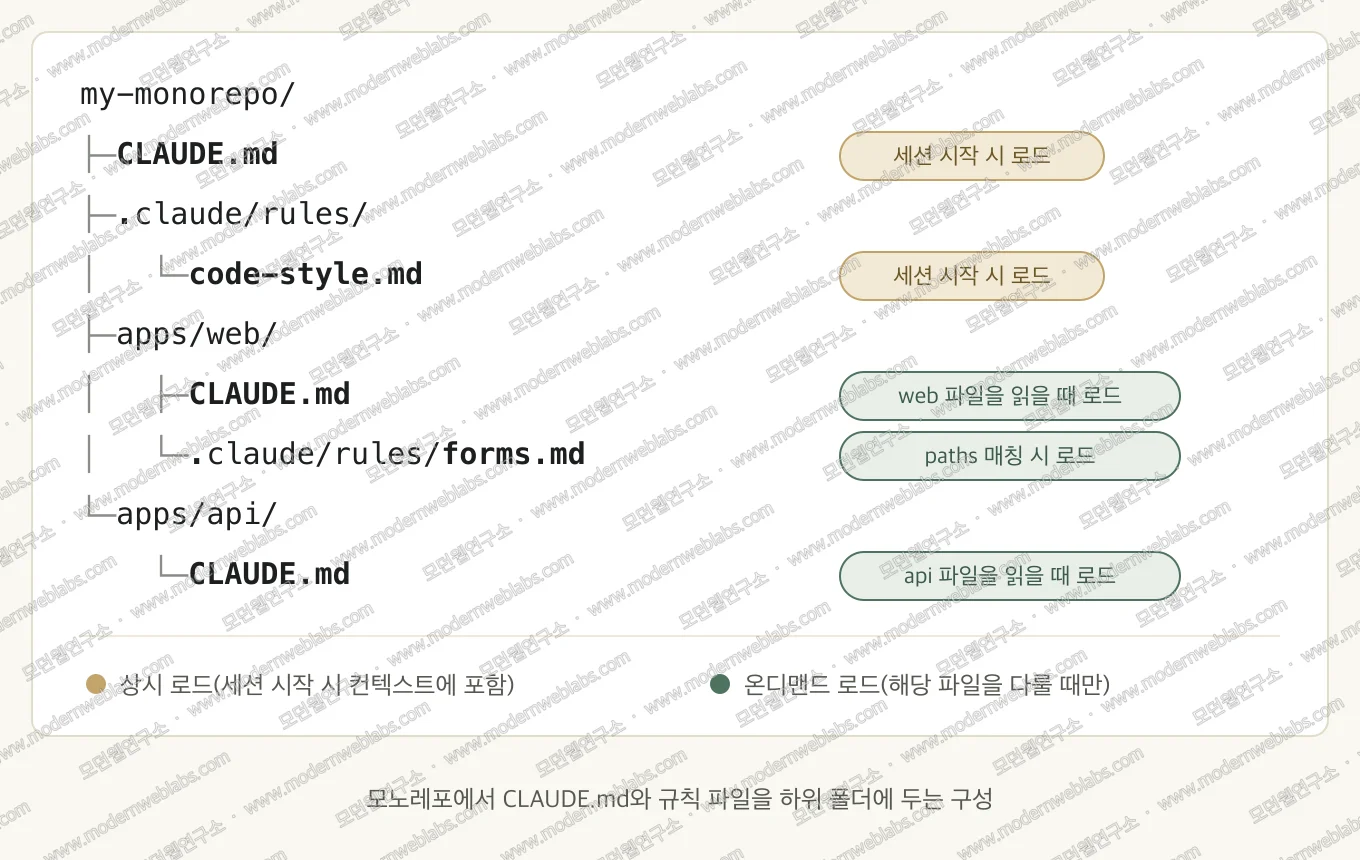
Every addition is labeled "Modern Web Labs extra tip" in the text so it stands apart from the original. Readers can trust both sources only when they can see where Anthropic's official curriculum ends and our additions begin.
Where to start
Chapter 1, "What are skills" and Chapter 2, "Creating your first skill" are live right now. If skills are new to you, start with the examples in Chapter 1; if you already know the concept, jump to Chapter 2 and write a SKILL.md yourself.
Chapters 3 through 6, which cover deploying and governing Claude Code across a team, are available to clients who have worked with Modern Web Labs on consulting or training. For skill design and governance shaped to your own team, see our consulting overview. When the premium chapters open to the public, the newsletter will carry the news first.
Claude Code official documentation, Agent Skills. The primary source for skill structure and configuration options.
↩Anthropic, Introduction to agent skills (Skilljar). The original course behind the Korean tutorial.
↩
Originally published at Modern Web Labs (www.modernweblabs.com). © Modern Web Labs. All rights reserved.
Newsletter
Notes vetted by enterprise practitioners, every two weeks.
Notes on Claude Code, GitHub Copilot, AI-native engineering strategy, and adoption case studies, curated every two weeks.
Modern Web Labs · Consulting
You read it. Now bring it into your team.
If the patterns in this post fit your situation, start with a short conversation about how to apply them.
How we can help
Claude Code · GitHub Copilot
Two-day hands-on plus AI-graded in-house certification
AI-Native Strategy
Redesign operating standards, measurement, and governance
Web Platform
Building full-stack services on Next.js